Understanding PRS Competition and Rifle Requirements
What is the Precision Rifle Series?
The Precision Rifle Series is the premier bolt-action precision rifle competition in the United States. PRS matches test accuracy, speed, and positional shooting across multiple stages set at varying distances and from different positions. Competitors shoot targets ranging from 50 to 1,400 yards, engaging steel at close range, then transitioning to longer-distance target arrays while moving between positions like prone, kneeling, and barricade. PRS attracts shooters of all skill levels and offers divisions tailored to different rifle types, experience levels, and competition goals.
PRS Competition Divisions
- Open: Any bolt-action rifle up to .30 caliber, velocities under 3,200 fps. Most flexible category. Common entry point for new competitors and preferred by experienced shooters for cartridge flexibility.
- Tactical: Restricted to .308 Winchester or 5.56 NATO, emphasizing practical cartridges.
- Sportsman: Locked to 6.5 Creedmoor for a controlled, level competition environment.
- Production: Spending limits on both rifle and optic; competitors must use production-grade equipment.
- Gas Gun: Open to semi-automatic platform shooters.
Dominant Calibers in PRS Competition
The 6mm family dominates PRS competition, particularly in the Open division. 6mm Creedmoor, 6mm BR, and 6XC offer the low recoil necessary to spot impacts without moving the rifle, a critical advantage in fast-paced competition stages. The 6.5 Creedmoor remains popular across Sportsman and Tactical divisions, delivering sufficient wind-bucking capability for long-range strings while maintaining manageable recoil. These cartridges balance velocity, powder efficiency, and bullet availability to enable match-winning accuracy. Mile High Shooting offers custom builds in all competitive calibers, ensuring your rifle matches your chosen division and stage requirements.
Building Your Competition-Ready PRS Rifle
Key Specifications for a PRS Rifle
Key specifications:
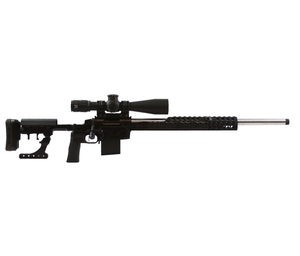
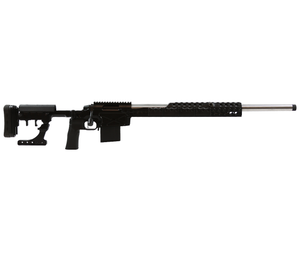
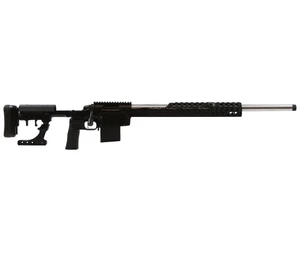
- Chassis: Aluminum chassis systems from manufacturers like Spuhr, MDT, KRG and XLR Industries replace traditional wood or synthetic stocks on purpose-built PRS rifles. Unlike fixed stocks, chassis systems offer almost infinite adjustment of length of pull, comb height, and recoil pad position, allowing competitors to dial in a consistent cheek weld and trigger reach across any shooting position or layer of clothing.
- Barrel: Match-grade barrels typically measure 26 inches with a heavy or sendero profile, adding mass that dampens harmonic vibration during firing. The added rigidity helps maintain point of impact consistency across long strings of fire, where a lighter hunting barrel would walk shots as it heats up.
- Rail System: Picatinny and ARCA rails replace the sporter-style bases found on hunting rifles, giving competitors a versatile and repeatable mounting platform for scopes, bipods, and andcillary gear. ARCA in particular has become the PRS standard, allowing quick repositioning of a bipod or front rest without tools between stages.
Mile High PRS Builds incorporate Proof Research match-grade barrels and premium actions into building the most accurate precision rifles available.
Mandatory and Recommended PRS Equipment
- Competition Tripod: A quality tripod serves as a stable support platform for engaging targets from standing or awkward positional stages where a bipod is not practical. Many stages require competitors to shoot unsupported or from barriers, and a tripod gives you a consistent, repeatable anchor point that a hasty rest cannot provide.
- Rear Bag: A rear bag sits under the toe of the stock to provide elevation control and reduce movement during recoil. Competitors manipulate the bag by squeezing or releasing it to make small elevation adjustments without breaking position, a technique that becomes essential at distances beyond 500 yards.
- Kneeling Pad: Hard or rocky terrain makes sustained kneeling positions punishing without proper padding. A dedicated kneeling pad protects your knee and keeps your focus on the target rather than discomfort, and most experienced competitors keep one clipped to their gear bag for quick deployment.
- Optic: A first-focal-plane scope in the 5-25x or 6-36x range is the practical standard for PRS competition. First-focal-plane reticles scale with magnification, meaning your mil or MOA holdovers remain accurate at any power setting, which matters when you are transitioning quickly between targets at different distances on a timed stage.
Frequently Asked Questions About PRS Rifles
What is PRS and what rifle do I need to compete?
The Precision Rifle Series is the premier bolt-action precision rifle competition in the US. Entry-level rifles need a bolt-action mechanism, a quality scope, and chambering in a competition-approved cartridge. The Open division offers the most flexibility, accepting any bolt-action rifle up to .30 caliber. Beginning competitors can start with a standard hunting rifle in Production or Tactical divisions, but a dedicated PRS build delivers advantages across all divisions.
What are the equipment rules for PRS competitions?
PRS equipment rules vary by division but generally mandate specific cartridges, rifle types, and optic limitations. All divisions require bolt-action rifles with detachable magazines. The Sportsman division enforces a 13-pound weight limit that includes the rifle, optic, muzzle device, bipod, empty magazine, and all detachable accessories. Open, Tactical, Production, and Gas Gun divisions do not impose weight limits, which is why many competitive Open division rifles run well above 20 pounds for added stability and recoil management. Most matches require competitors to supply a competition tripod, rear bag, and kneeling pad for stage support. Optics must be mounted within specific parameters and most competitors use 5-25x or 6-36x variable scopes. Accessories like bipods and wind flags must meet match-specific requirements. Division-specific rules govern cartridge velocity, spending limits on rifles and optics, and permitted modifications. For complete division requirements, review the official PRS Rules & Standard Operating Procedures.
How is a PRS rifle different from a hunting rifle?
PRS rifles and hunting rifles serve different purposes, leading to distinct design differences. Hunting rifles prioritize field portability and quick target engagement with lighter profiles and traditional stocks. PRS rifles optimize for precision consistency through heavy match-grade barrels, adjustable aluminum chassis, Picatinny rail systems, and competition-tuned triggers. Hunting rifles rarely include the accessory rails and adjustment capabilities necessary for competition. A dedicated PRS build removes equipment limitations when competing against shooters using purpose-built platforms. While adaptive shooters can compete with hunting rifles in certain divisions, a custom PRS rifle gives you a performance advantage when equipment matters.
Does Mile High Shooting offer PRS-ready custom builds?
Yes. Mile High Shooting's custom builds are competition-ready PRS rifles engineered to division specifications. Each build incorporates Proof Research match-grade barrels and premium actions selected for competition accuracy and reliability.