Types of Rifle Barrels
Rifle barrels fall into a few distinct categories defined by construction material, rifling method, and fit. Understanding these categories narrows your selection before you consider caliber and profile.
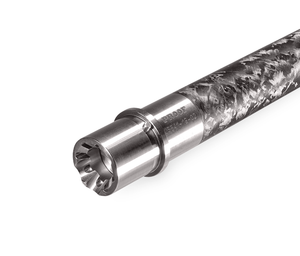
Carbon Fiber Rifle Barrels
Carbon fiber barrels use a match-grade 416R stainless steel liner wrapped in aerospace-grade carbon fiber, producing a barrel up to 64% lighter than a comparable steel blank. Proof Research leads this category, and their helical wrapping process helps dissipate heat faster between strings for a more consistent point of impact. These are a popular choice for PRS competitors and backcountry hunters who need to cut weight without sacrificing barrel length or accuracy.
Match Grade Stainless Steel Barrels
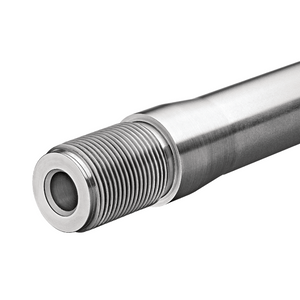
Match grade stainless barrels are machined from 416R stainless steel, rifled using single-point cut or button rifling, and lapped for consistent bore geometry from chamber to muzzle. Available as blanks requiring full gunsmith installation or as pre-fits chambered for specific actions, these are the standard choice for competition shooters who want predictable accuracy and barrel life at a lower price point than carbon fiber.
Pre-Fit and Barreled Actions
Pre-fit barrels are chambered, threaded, and headspaced at the factory for direct installation on compatible actions, allowing a barrel swap with basic tools and no lathe work. Barreled actions go a step further, delivering a complete action and barrel assembly ready to drop into a chassis or stock. Pre-fits are available for Impact Precision, Remington 700, Zermatt Arms, Defiance, Tikka T3x, Savage, and Ruger Precision Rifle platforms. For builders starting from scratch, a quality barreled action paired with an AI-pattern chassis is one of the fastest paths to a competition-ready precision rifle.
How to Choose the Right Rifle Barrel
Selecting a rifle barrel comes down to four variables: material, profile, caliber and twist rate. Getting all four right for your intended use produces the most accurate and consistent build.
Barrel Profile and Weight
Barrel profile refers to the external contour, which affects stiffness, heat capacity, and total weight. Heavy Palma and bull profiles offer maximum stiffness for bench and prone competition. Lighter sporter and sendero profiles suit hunting and backcountry rifles where total weight matters. Carbon fiber wrapping lets you run a heavier liner inside a lighter overall barrel, giving you the stiffness of a heavy contour at closer to sporter weight.
Caliber and Twist Rate
Twist rate is expressed as a ratio such as 1:8 or 1:10, meaning the rifling completes one full revolution in that number of inches. Faster twist rates stabilize longer, heavier projectiles; slower twist rates suit shorter, lighter bullets. For 6.5 Creedmoor, the most common competition twist is 1:8, which stabilizes 130 to 147 grain bullets across the full range used in PRS. For .308 Winchester, a 1:10 twist handles 168 to 175 grain match bullets reliably. Magnum cartridges like .300 Win Mag and .300 PRC typically use 1:9 or 1:10, depending on the bullet weight you intend to run. Confirm your intended bullet weight before selecting a twist rate, as an incorrect twist produces inconsistent stability and degraded accuracy.
Gain Twist Rifling: Most precision barrels use a uniform twist rate from chamber to muzzle, but gain twist rifling takes a different approach. A gain twist barrel starts with a slower rate at the chamber and gradually increases to a faster rate toward the muzzle. This progressive engagement reduces bullet deformation during the initial contact with the rifling, which can improve accuracy and extend barrel life compared to a conventional uniform twist. Gain twist barrels are less common than standard cut or button-rifled options, but they are worth considering for shooters running high-velocity cartridges or heavy-for-caliber bullets where minimizing jacket stress is a priority. For a deeper look at how gain twist fits into the broader landscape of rifling methods, see American Rifleman's overview of rifling types.
Barrel Length and Gas System Fit
Barrel length affects muzzle velocity, overall rifle balance, and handling in field positions. For precision bolt-action rifles, 24 to 26 inches is the most common range for magnum cartridges, and 20 to 24 inches for short-action calibers like 6.5 Creedmoor and .308.
For AR-platform builds, barrel length must match the intended gas system:
- carbine (7 to 10 inches)
- mid-length (12 to 14.5 inches)
- rifle-length (16 inches and above)
Using a barrel length and gas system that are mismatched produces inconsistent cycling pressures and accelerated wear on bolt components.
For Competition Precision Rifle Builders
PRS and ELR competitors prioritize barrels with the tightest available tolerances, proven accuracy at extended ranges, and enough heat capacity for multi-stage match days. According to Precision Rifle Blog, barrels from Proof Research are used by approximately 12% of top-200 PRS shooters and are the primary carbon fiber option in the Mile High Shooting barrel inventory. For builders prioritizing cost-per-round accuracy, match-grade stainless pre-fits in 6.5 Creedmoor or .308 offer a proven and more accessible path to sub-half-MOA performance.
Rifle Barrel FAQs
What types of rifle barrels does Mile High Shooting carry?
Mile High Shooting carries carbon fiber rifle barrels, match grade stainless steel barrels, and pre-fit barreled actions for bolt-action platforms. Proof Research is the primary barrel brand, with options available for Remington 700 footprint actions, Tikka, Savage, Zermatt Arms, and others.
What is the difference between a match grade barrel and a standard barrel?
A match grade barrel is manufactured to tighter dimensional tolerances than a factory barrel, typically using 416R stainless steel, single-point cut or precision button rifling, and hand-lapping for a consistent bore finish. The result is more uniform bullet engagement, better concentricity, and a tighter grouping potential at distance. Standard production barrels use less precise rifling methods and wider tolerance windows, which limits repeatable accuracy beyond 300 to 400 yards.
How do I choose the right barrel profile and twist rate?
Choose your profile based on weight and intended use: heavy Palma or bull profiles for stationary competition, lighter sporter or sendero profiles for field use. For twist rate, a good starting point is 1:8 for 6.5 Creedmoor with 140 to 147 grain bullets, and 1:10 for .308 Winchester with 168 to 175 grain bullets. When in doubt, a faster twist stabilizes a wider range of bullet weights.