Understanding NRL Hunter Competition
What is NRL Hunter?
NRL Hunter is a competition format that tests precision rifle skills in hunting-like scenarios. Competitors shoot 15-20 stages over two days, engaging targets at distances typically ranging from 200 to 700 yards, with some stages extending beyond 1,000 yards. Unlike precision rifle series (PRS) competitions, NRL Hunter requires hunting-legal rifles and incorporates natural terrain, field positions, and unpredictable elements that mirror real hunting conditions. The format has grown rapidly among hunters and competition shooters seeking a middle ground between casual hunting accuracy and tactical rifle sport.
NRL Hunter Divisions Explained
- Factory Division: Built around unmodified factory rifles from an approved manufacturer list with minimal aftermarket parts allowed. This division welcomes hunters using production rifles without extensive customization.
- Open Light Division: Rifles under 12 pounds including all attachments (scope, bipod, etc.) except magazine and ammunition. Must meet a Power Factor minimum of 380,000 to ensure adequate terminal ballistics.
- Open Heavy Division: Rifles under 16 pounds with the same Power Factor requirement. Heavier rifles allow for larger calibers or more forgiving recoil impulses while maintaining the 380,000 Power Factor threshold.
- Skills Division: Any rifle configuration with no weight or Power Factor restrictions. Coaching is allowed during competition, making it ideal for shooters focused on learning and skill development at a lower entry cost.
Rifle Specifications and Requirements
Power Factor and Caliber Limits
Every NRL Hunter rifle must comply with strict Power Factor and caliber regulations. Maximum caliber is .30 and maximum velocity is 3,275 fps. Power Factor is calculated as bullet weight in grains multiplied by velocity in feet per second; the result must equal or exceed 380,000. For example, a 140-grain bullet at 2,800 fps yields a Power Factor of 392,000, meeting the minimum requirement.
These restrictions ensure fair competition, manageable recoil across divisions, and adequate bullet performance downrange. Exceeding the velocity cap results in disqualification, so precision hand-loads and chronograph verification are critical before competition.
Popular NRL Hunter Calibers
- 6.5 Creedmoor leads the NRL Hunter field due to its excellent ballistics, low recoil, and reliable ammo availability. The cartridge easily meets Power Factor requirements with 140-grain or heavier projectiles while maintaining accuracy to 1,000+ yards.
- .308 Winchester remains popular for shooters preferring a versatile, widely available round. It demands heavier bullets to reach Power Factor minimums but delivers proven terminal performance.
- 6mm Creedmoor appeals to precision shooters seeking minimal wind drift and flat trajectories. Balancing faster bullet velocity with the Power Factor requirement makes this caliber competitive in open divisions.
Building Your NRL Hunter Rifle
Factory Division Option
If you already own a factory rifle from an approved manufacturer, you may be eligible for factory division with minimal modifications. A quality scope, hunting-grade bipod, and verified ammunition loading ensure compliance. However, most factory rifles require hand-load development to meet the 380,000 Power Factor threshold, making ammunition expertise essential.
MHSA Open Division Build
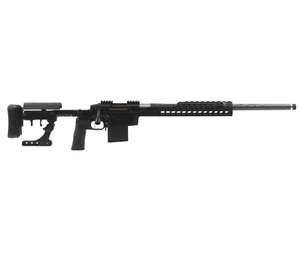
Mile High Shooting assembles NRL Hunter-ready custom rifles under the MHSA brand, currently offered in 6.5 Creedmoor with a 24" barrel. Open division builds feature premium actions (Impact Precision 737R and Defiance Ruckus are typical choices), Proof Research carbon fiber barrels for weight management within the 12-pound Open Light cap, and AICS-pattern magazines for reliable feeding during timed blind stages. Each build is weight-verified and configured for division compliance before delivery. Contact our team for current availability and configuration options.
Component Considerations by Division
- Barrels: Proof Research carbon fiber barrels in sporter or light-tactical profiles are the practical choice for Open Light, where the 12-pound limit leaves little margin. Open Heavy allows heavier contours that improve harmonic stability and recoil management at the cost of weight.
- Chassis: Carbon fiber and magnesium chassis (ranging from approximately 1.8 to 5 pounds) suit Open Light builds. Aluminum chassis are better suited for Open Heavy where the extra weight aids recoil control. ARCA-integrated forends and M-LOK compatibility are standard priorities in either division.
- Actions: Impact Precision 737R and Defiance Machine Ruckus are preferred for Open division builds due to their match-grade tolerances and compatibility with the Rem 700 footprint.
- Optics: First-focal-plane scopes in the 4-16x or 5-25x range from Nightforce, Vortex, or Leupold are the standard for NRL Hunter. FFP reticles allow accurate holdovers at any magnification setting, which matters during rapid target transitions at varying distances.
NRL Hunter Frequently Asked Questions
Can I use my existing hunting rifle for NRL Hunter competition?
Possibly, if it is from an approved manufacturer and unmodified for factory division. However, most hunting rifles struggle to meet the 380,000 Power Factor requirement without careful ammunition hand-loading. Open divisions demand specific weight limits and Power Factor compliance that hunting rifles often cannot achieve. Consider a custom build if your current rifle lacks the precision components and verified compliance documentation needed for competition.
What is Power Factor and why does it matter in NRL Hunter?
Power Factor is calculated as bullet weight multiplied by velocity and must reach 380,000 to ensure adequate terminal ballistics and fair competition across divisions. A 140-grain bullet at 2,800 fps yields 392,000 Power Factor, meeting requirements. Falling short results in disqualification, so you must chrono-verify your hand-loads before competition.
How does NRL Hunter differ from precision rifle series (PRS)?
NRL Hunter requires hunting-legal rifles, eliminates bipod-only shooting stages, incorporates natural terrain and field positions, and spans two days over 15-20 stages typically at 200-700 yards. PRS focuses on precision rifle performance with specialized platforms, longer distances, and tactical stage designs. NRL Hunter bridges hunting authenticity with competition structure, making it ideal for hunters entering precision shooting.
Which caliber should I choose for my NRL Hunter rifle?
6.5 Creedmoor is the most popular choice, balancing Power Factor compliance, excellent ballistics, manageable recoil, and ammunition availability. .308 Winchester works well for shooters seeking versatility and proven terminal performance. 6mm Creedmoor attracts precision shooters prioritizing flat trajectories and minimal wind drift. Consider your preferences for recoil, ammunition cost, and wind performance; all three calibers comfortably meet NRL Hunter requirements within regulatory velocity caps.